
What is GTM Automation?
Definition
GTM automation (go-to-market automation) is the use of integrated software workflows to capture, enrich, qualify, route, and engage sales leads automatically across marketing and sales systems.
Instead of relying on manual research, spreadsheet tracking, and human lead assignment, GTM automation connects tools such as CRM platforms, enrichment databases, and outreach software so that leads move through the sales pipeline automatically.
In practical terms, GTM automation allows sales teams to focus on conversations while software manages the operational infrastructure behind lead management.
Why GTM Automation Matters
Modern B2B sales teams operate in environments where lead volume, data complexity, and response speed determine revenue performance.
Companies implementing structured GTM automation typically experience:
3–5× increase in outbound prospecting capacity
60–80% reduction in manual prospect research time
faster lead response times
improved data accuracy across CRM systems
These improvements compound across the entire revenue pipeline.
The Gruppo Integritas GTM Automation Framework
GTM automation systems typically consist of six interconnected layers.
1 - Lead Capture
Prospects enter the system through forms, inbound requests, APIs, or prospecting databases.
2 - Data Enrichment
External data providers supply additional firmographic and contact information.
3 - Lead Scoring
Automation evaluates whether the prospect matches the company’s ideal customer profile.
4 - Lead Routing
Qualified leads are automatically assigned to the appropriate sales representative.
5 - Outreach Automation
Sales engagement tools initiate email or multi-channel sequences.
6 - Revenue Analytics
All activity is tracked inside CRM dashboards and revenue reporting systems.
How GTM Automation Works
A typical GTM automation workflow follows a predictable sequence.
Step 1
A prospect fills out a form, downloads a resource, or is added through a prospecting database.
Step 2
Automation triggers enrichment services that collect company information, email addresses, and firmographic data.
Step 3
Lead scoring rules evaluate whether the contact fits the ideal customer profile.
Step 4
Routing rules assign the lead to the correct sales representative.
Step 5
An automated outreach sequence begins, ensuring immediate engagement.
Step 6
All activity is logged in the CRM automatically.
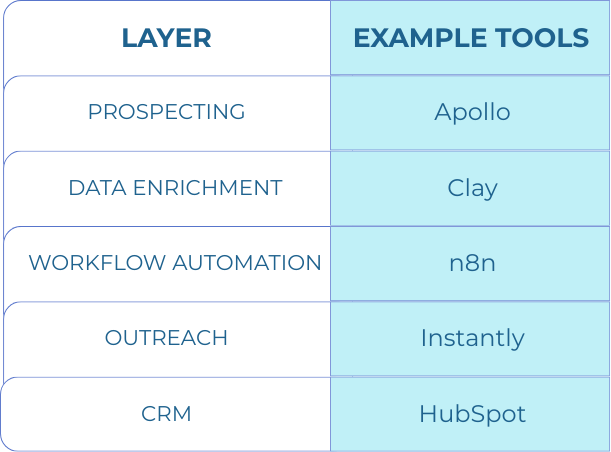
Example GTM Automation Stack
Common Mistakes in GTM Automation
Automation systems frequently fail when organizations automate processes that are poorly designed.
Common mistakes include:
automating incomplete data pipelines
using too many disconnected tools
ignoring lead qualification logic
failing to monitor automation performance
Successful GTM automation requires both system architecture and operational discipline.
FAQ
What tools are commonly used for GTM automation?
Typical tools include Clay for data enrichment, Apollo for prospecting, workflow platforms such as n8n or Zapier, outreach platforms like Instantly, and CRM systems such as HubSpot or Salesforce.
What is the goal of GTM automation?
The goal is to reduce manual operational work so sales teams can focus on high-value conversations with qualified prospects.
If your organization is exploring GTM automation or building a modern outbound system, the team at Gruppo Integritas designs and implements end-to-end go-to-market automation systems.
Our team works with growth-stage companies to build lead pipelines that capture, enrich, route, and engage prospects automatically.
You can learn more about our approach or schedule a strategy conversation with Gruppo Integritas to evaluate how automation can improve your revenue operations.
Book a free GTM audit and start fixing what’s actually leaking revenue.
